

In this AffPapa exclusive, Rosa Ochoa reflects on over 20 years in the iGaming industry, sharing her perspective on LATAM’s rapid evolution, the strategic balance of...

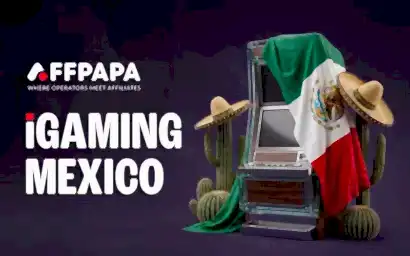
A $970 million iGaming market in 2026, double-digit annual online growth, and a co-hosted FIFA World Cup? You heard right. iGaming Mexico is picking up speed and is about to become the global betting spotlight.
We know that you can’t help but wonder if there’s a chance to reap what the iGaming Mexico market is sowing, so we have prepared a cheat sheet to equip you with everything that is necessary to know before entering the world of iGaming in Mexico.
Table of Contents
With an approximate population of over 131 million, of which over 97% use smartphones and more than 80% access the internet, the iGaming Mexico market is expected to grow from $970 million in 2026 to $1.96 billion by 2031 with a CAGR of 15.11%. We also must mention that the broader gambling sector is growing at a CAGR of 4.56%. This gap matters because it shows the structural change away from land-based casinos toward digital-first gambling in Mexico. This is further proved by an estimated 8 million active iGaming players recorded in Mexico in 2025.
Data from the World Bank Group shows that 80% of Mexico’s population was urbanized in 2024, with estimates showing that the number has increased to 88% in 2026. Combined with a demographic profile of a median age of under 30, Mexico is firmly standing as the second leading power in LATAM after iGaming Brazil. Moreover, in February 2026, the biggest Mexican iGaming and sports betting platform, Caliente, ranked at the 4th position as the most visited gambling website in the world with 47.91 million visits.
What’s driving this? A mobile-first population, younger and more tech-forward players entering the market, improved payment structures, and operators finally treating iGaming Mexico as a separate market, not just a Spanish-language extension of the region.
Mexico’s online gambling regulation really is a coin with two sides; for licensed operators, it’s a trust signal, but a risk factor for unlicensed ones. In Mexico, iGaming is supervised by the regulations and administrative decisions of the Ministry of the Interior (SEGOB), where the main authority is the Gaming and Lotteries Bureau (DGJS), which operates under the Federal Gaming and Raffles Law of 1947. Yes, the law is old, no question there, but it’s still the foundation of the current regulatory system.
Sports betting, casinos, and raffles are allowed if they follow the licensing and compliance requirements, where the only authority empowered to give permits for betting and iGaming in Mexico is the DGJS.
For operators, this translates into a simple structure:
One regulator, one framework, one door to knock on.
Licensing is one of the biggest entry barriers (and one of the strongest protections) in iGaming Mexico.
Felicidades to Mexicans, as a gambling license in Mexico is granted only to local commercial entities. Stop panicking; for foreign operators to offer iGaming services legally, they must either establish a Mexican entity or partner with a local license holder. A gaming license in Mexico is granted for 25 years and has an option to extend it for an additional 15 years. Four main license categories are granted, including for horse and greyhound racing tracks with betting, jai alai (cesta punta) fronton arenas, remote betting centres for internet sports betting, and betting halls or “poker rooms”. This unusually long duration alone makes Mexico an attractive gambling market compared to more short-term licensing jurisdictions.
The upside? Long-term security and operational stability. The trade-off? Higher legal, compliance, and structural costs upfront.
At the moment, there is no separate gambling license in Mexico for working in the iGaming market, so operators must first either get a land-based license approved by the SEGOB or partner with an existing licensed Mexican entity, and only after that can they receive authorization to provide online casino services. To ease your job, the most commonly used partnership methods are:
Taxation on iGaming in Mexico remains a really closely watched pressure point, as online gambling revenue is subject to a 30% tax, placing the jurisdiction on the higher end of taxing globally. To add salt to the wound, Mexico’s Senate approved a fiscal package in 2025, which proposed increasing the iGaming tax rate from 30% to 50% and adding an 8% tax on games with violent content.
The confirmation of the Special Tax on Products and Services (IEPS) to increase Mexico’s iGaming tax to 50% alone has impacted margin planning, bonus structures, and long-term market forecasting. If you’re planning to enter the iGaming market in Mexico in 2026, then you need to add tax volatility into your operations, because the market is profitable only when cost structures are localized and realistic.
Payments deserve a separate paragraph here, because honestly, a lot depends on them. The most popular payment methods used in iGaming Mexico are:
Don’t forget, no matter what kind of payment system you offer, each one must be integrated with anti-money laundering (AML) and know your customer (KYC) processes.
The package of the required documents to get a gaming license in Mexico can be split into three main parts: documents about the company and the owners, fair gaming compliance documents, and AML and financial security compliance papers. Important note for operators: if their documents are issued outside of Mexico, then they must be apostilled and translated into Spanish. Let’s take a deeper look into each document type:
Documents about the company and its owners – founding documents and amendments, financial statements and balance sheets, shareholders and main personnel, declaration of criminal record and bankruptcy, any business relation with other licensed operators
Fair gaming compliance documents – policy for responsible gaming, measures for protecting players against addiction, game fairness and user data protection procedures, certification of RNG algorithms and mechanisms
AML and financial security compliance – anti-money laundering and counter-terrorism financing policy, KYC protocols, programs for monitoring suspicious transactions, appointment of a responsible officer for AML requirements
Understanding the Mexican player should be a top priority for iGaming operators. For your own sake, we have gathered everything, and we mean everything, that you need to know about the players, their favorite games, and even the devices they use to access iGaming in Mexico.
Let’s talk demographics and devices.
Turning to behavior and game preferences, iGaming Mexico shows an interesting pattern; despite bet sizes being small, betting frequency is quite high. If you want to earn a special place in the players’ hearts, remember that they really like localized experiences that include Spanish-language interfaces, promotions that are culturally close, and bets connected to major tournaments and the Liga MX. For this purpose, casino affiliate programs in Mexico are gradually expanding as well, and presenting players with promotions and offers that align with their needs. Desktop optimization is honestly secondary because less than 44% of the Mexican population owns a computer; it’s more logical to focus on lightweight apps that perform well on Android devices, as the Android operating system holds a 66% market share in the country.
| Sports betting | 50% | Football far ahead of any other sport |
| Casino games | 30% | Slots, RNG, blackjack, poker |
| Lottery and live dealer casinos | 20% | Growing participation in lottery and bingo, live games with Spanish-speaking tables |
Pro tip: Cross-vertical strategies perform best in iGaming Mexico.
The Association of Permit Holders, Operators, and Suppliers of the Entertainment and Gambling Industry (AIEJA) has urged the government to take the opportunity and transform Mexico’s online gambling regulations to support the already fast growth of the iGaming sector. As AIEJA estimates, the country’s illegal online betting market could potentially be valued at $450 million, with around 60% of platforms operating without a gambling license in Mexico. This is mainly the reason why the country wants to establish a National Institute of Games and Lotteries under the Ministry of the Interior to more extensively regulate and inspect the sector. The trade body believes that Mexico could be positioned as a key regional entertainment and tourism spot and double visitations from 5 million to 10 million by 2030.
Coincidentally (or not), the trade body’s urges come hand in hand with Mexico co-hosting the FIFA World Cup 2026, which will definitely put the country at the center of global sports attention. For iGaming in Mexico, this is a once-in-a-lifetime acquisition moment, as sports betting volumes are expected to jump alongside increased media exposure.
Not to scare you away, but we wanted to keep the less exciting news for last. Mexico is debating a new legislative proposal for 2026, which would ban betting and casino advertising between 6 am and 10:30 pm for all types of media platforms in an effort to protect under-18s from being exposed to gambling promotions. At the moment, the bill is under review by the Board of Directors of the Chamber of Deputies of Mexico.
The real challenge for the iGaming industry is understanding Mexico on its own terms, and lucky for you, the affiliate-led AffPapa Conference Cancun is returning to Mexico with its full force and is scheduled to take place between November 23 and 25, 2026. Join AffPapa to gain insights about the market and explore your next launch location.
What’s the size of the iGaming market in Mexico?
The iGaming market in Mexico is valued at $970 million in 2026 and is expected to grow to $1.96 billion by 2031 with a CAGR of 15.11%.
How to enter the Mexican iGaming market?
To enter the Mexican iGaming market, operators must either have a Mexican entity or collaborate with a local license holder. Having a land-based license approved by the SEGOB is mandatory, after which operators can be authorized by the DGJS to offer iGaming products.
What kind of gambling is most popular in iGaming Mexico?
The most popular form of gambling in Mexico is sports betting at 50%, followed by casino games (30%), lotteries, and live dealer casinos (20%).
What’s the legal gambling age in Mexico?
The legal gambling age in Mexico is 18, according to the 2004 amended legislation.
How is iGaming in Mexico taxed?
iGaming in Mexico is currently taxed at a 30% rate; however, the government recently confirmed the 2026 fiscal package to increase the iGaming tax to 50%.






 ReferOn shortlisted for “Best Affiliate Software” at SiGMA Awards
 ELA Games discusses game innovation at HIPTHER Prague
 MyStake CEO Andres Markou exposed as AI generated identity ReferOn shortlisted for “Best Affiliate Software” at SiGMA Awards ELA Games discusses game innovation at HIPTHER Prague